
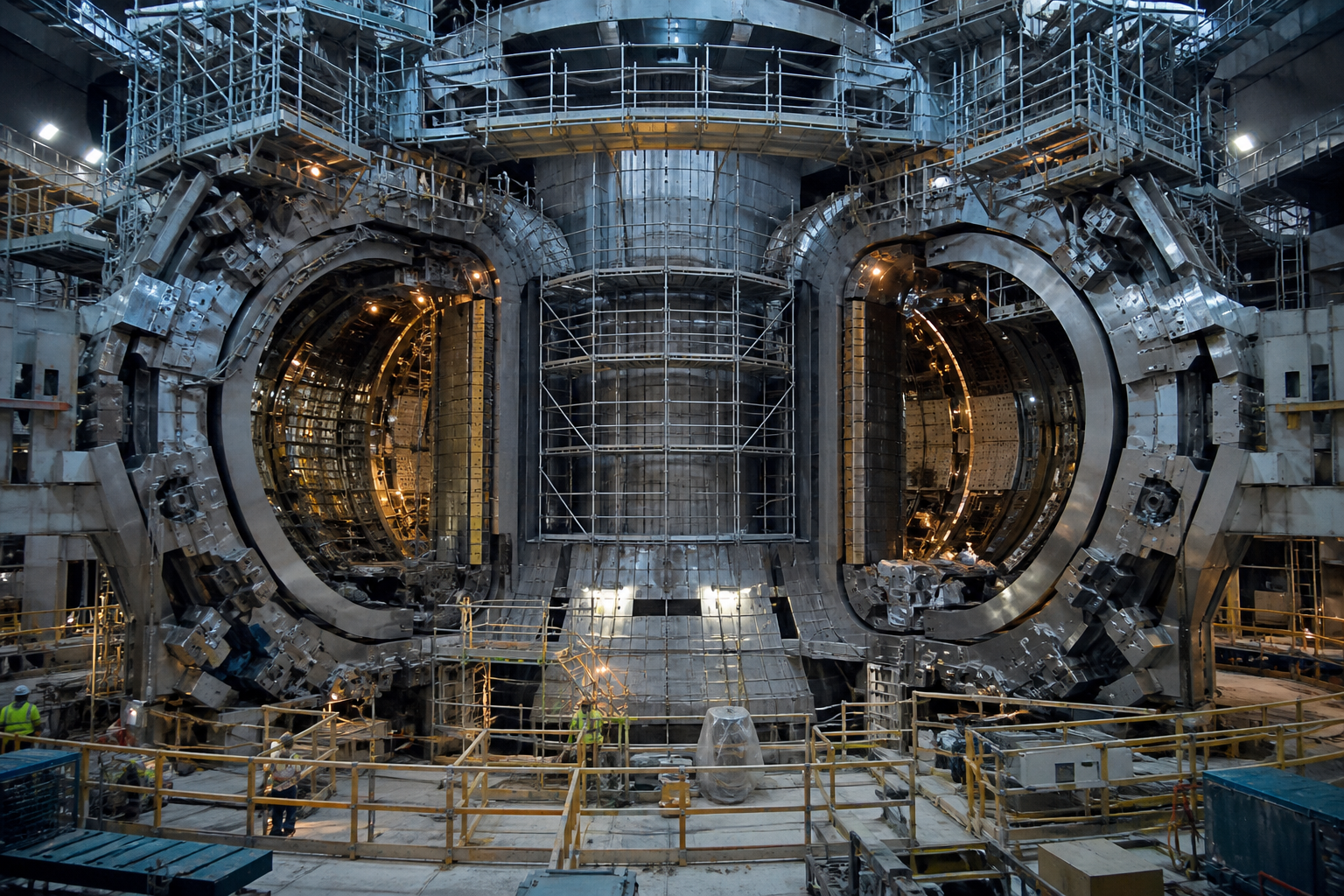
In November 1985, the leaders of the United States and the Soviet Union met in Geneva. Ronald Reagan and Mikhail Gorbachev represented two rival superpowers with thousands of nuclear weapons aimed at each other. Yet they agreed that their countries should cooperate in the peaceful development of controlled thermonuclear fusion. Their joint statement described this work as being “for the benefit of all mankind.” The idea that helped create ITER was therefore not only scientific. It was also political: even dangerous rivals could work together on a shared human future.
1985年11月、米国とソ連の指導者がジュネーブで会談しました。ロナルド・レーガンとミハイル・ゴルバチョフは、何千もの核兵器を互いに向けた二つの対立する超大国を代表していました。しかし彼らは、両国が制御された熱核融合の平和的開発で協力すべきだということに合意しました。共同声明は、この仕事を「全人類の利益のために」行われるものだと述べました。したがってITERの創設を助けた考えは、科学的だけではありませんでした。それは政治的でもありました。危険なライバルでさえ、共有された人類の未来のためにともに働ける、ということです。
Fusion is the process that powers the sun. It joins light atomic nuclei and releases enormous amounts of energy. If scientists can harness this process on Earth, fusion could provide large amounts of energy without producing carbon dioxide during operation. However, creating and controlling fusion requires temperatures of more than 100 million degrees Celsius, powerful magnets, advanced materials, and extremely precise engineering. Building a machine large enough to test all these systems is an expensive and risky undertaking.
核融合は太陽にエネルギーを与える過程です。軽い原子核を結合させ、莫大な量のエネルギーを放出します。科学者が地球上でこの過程を利用できれば、核融合は運転中に二酸化炭素を出さずに大量のエネルギーを提供しえます。しかし核融合を作り制御するには、1億度を超える温度、強力な磁石、先進材料、極めて精密な工学が必要です。これらすべてのシステムを試験できるほど大きな機械を造ることは、高価で危険な事業です。
The United States, the Soviet Union, Japan, and Europe began working on the design of an international fusion machine in the late 1980s. China, South Korea, and India later joined the project. Today, ITER’s seven members are China, the European Union, India, Japan, South Korea, Russia, and the United States. Rather than making one country carry the full cost and risk, they agreed to pool resources, divide the engineering work, and share the scientific results.
米国、ソ連、日本、ヨーロッパは1980年代後半に国際的な核融合装置の設計に取り組み始めました。中国、韓国、インドは後にプロジェクトに加わりました。今日、ITERの7つのメンバーは中国、欧州連合、インド、日本、韓国、ロシア、米国です。一国に全費用とリスクを負わせるのではなく、彼らは資源をプールし、工学作業を分け、科学的成果を共有することに合意しました。
ITER’s financial structure reflects this ideal. Europe, as the host member, is responsible for about 45.6 percent of construction costs. Each of the other six members is responsible for about 9.1 percent. However, most of these costs are not paid as cash. About 90 percent of member contributions are in-kind contributions. One member may manufacture magnets, while another supplies heating equipment or parts of the vacuum vessel. In return, every member receives access to the project’s scientific results and intellectual property.
ITERの財務構造はこの理想を反映しています。ホストメンバーとしてのヨーロッパは、建設費用の約45.6パーセントを担います。他の6メンバーはそれぞれ約9.1パーセントを担います。しかしこれらの費用のほとんどは現金では支払われません。メンバー貢献の約90パーセントは現物貢献です。あるメンバーが磁石を製造し、別のメンバーが加熱装置や真空容器の部品を供給することがあります。見返りに、すべてのメンバーがプロジェクトの科学的成果と知的財産へのアクセスを受けます。
This arrangement spreads knowledge and industrial experience across many countries. It also makes the project unusually difficult to manage. Thousands of components made by different organizations must fit together with extreme precision. The members have different currencies, industries, regulations, and political priorities. Important decisions often require consensus. International cooperation is therefore one of ITER’s greatest strengths, but it can also add complexity.
この取り決めは、知識と産業経験を多くの国に広げます。それはまた、プロジェクトを管理するのを異常に難しくもします。異なる組織が作った何千もの部品が、極めて精密に組み合わさなければなりません。メンバーは異なる通貨、産業、規制、政治的優先事項を持ちます。重要な決定はしばしば合意を必要とします。したがって国際協力はITERの最大の強みの一つですが、複雑さも加ええます。
ITER has experienced serious delays. Under a schedule approved in 2016, its first plasma was expected in 2025, followed by full deuterium-tritium experiments in 2035. The revised plan now aims to begin research operations in 2034 and deuterium-tritium operations in 2039. Technical defects, the COVID-19 pandemic, manufacturing problems, and overly optimistic planning have all contributed to the delay. ITER will not generate electricity. Its main scientific goal is to produce 500 megawatts of fusion power from 50 megawatts of heating power inside the plasma.
ITERは深刻な遅延を経験してきました。2016年に承認されたスケジュールでは、最初のプラズマは2025年、その後完全な重水素・トリチウム実験は2035年と見込まれていました。改訂計画は今、研究運転を2034年に、重水素・トリチウム運転を2039年に始めることを目指しています。技術的欠陥、COVID-19パンデミック、製造問題、過度に楽観的な計画がすべて遅延に寄与しています。ITERは電力を生み出しません。主な科学目標は、プラズマ内の加熱電力50メガワットから核融合電力500メガワットを生み出すことです。
The delays have raised difficult questions about continued political support. Each member must keep providing money, equipment, and expertise over many years, even as governments and national priorities change. The United States, one of ITER’s founding partners, must obtain funding from Congress. A major reduction in American support would not necessarily end ITER immediately, but it could leave important systems unfinished and force the other members to renegotiate their responsibilities. Growing geopolitical tension also tests whether countries that compete in security and technology can continue to cooperate in science.
遅延は、継続的な政治的支援について難しい問いを提起しています。各メンバーは、政府や国家の優先事項が変わっても、何年にもわたって資金、装置、専門知識を提供し続けなければなりません。ITERの創設パートナーの一つである米国は、議会から資金を得なければなりません。米国の支援の大幅な削減は、必ずしもITERをすぐに終わらせるわけではありませんが、重要なシステムを未完成のままにし、他のメンバーに責任の再交渉を強いる可能性があります。増大する地政学的緊張もまた、安全保障と技術で競争する国々が科学で協力を続けられるかを試します。
ITER’s success should therefore not be measured only by its construction schedule. A private company controlled by one management team may be able to make decisions more quickly. ITER is attempting something different: building one of the world’s most complex machines through cooperation among countries that do not always trust one another. If it succeeds, its achievement will be more than a burning plasma. It will show that rival nations can still create and share knowledge for humanity. But if the project becomes too slow or expensive to complete, it may also show the limits of that ideal.
したがってITERの成功は、建設スケジュールだけで測られるべきではありません。一つの経営チームに支配された民間企業は、より速く決定できるかもしれません。ITERは何か違うことを試みています。いつも互いを信頼するとは限らない国々の協力を通じて、世界で最も複雑な機械の一つを築くことです。成功すれば、その達成は燃焼プラズマ以上のものになります。対立する国々がなお人類のために知識を作り共有できることを示すでしょう。しかしプロジェクトが完成するには遅すぎるか高すぎるようになれば、その理想の限界も示すかもしれません。
The historical, membership, and schedule details were checked against the official ITER project timeline, ITER member information, and Baseline 2024 explanation.
歴史、メンバーシップ、スケジュールの詳細は、公式のITERプロジェクト年表、ITERメンバー情報、Baseline 2024の説明に照らして確認されました。