
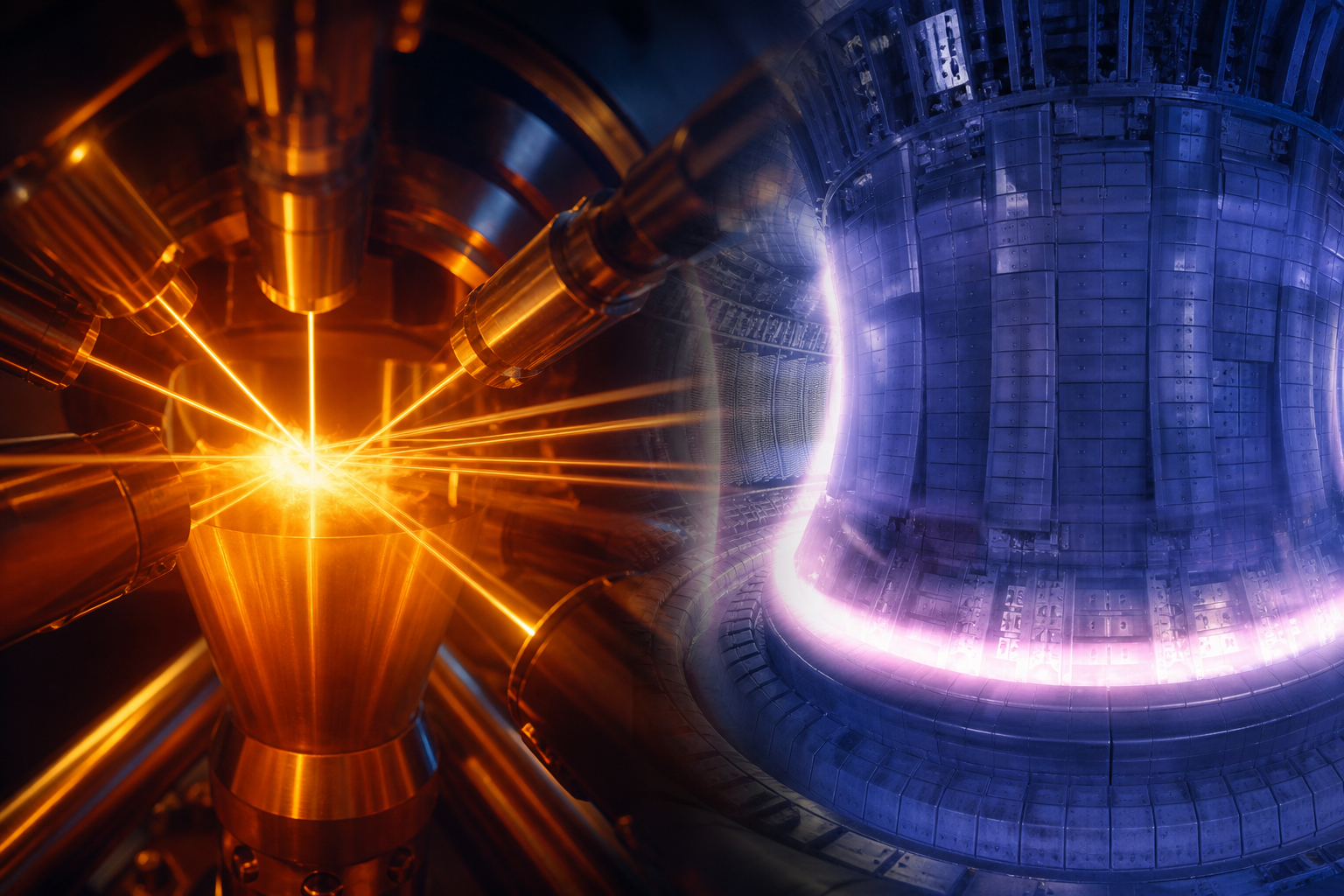
In January 2025, China announced that its Experimental Advanced Superconducting Tokamak, known as EAST, had maintained high-confinement plasma for 1,066 seconds. A few months later, the United States announced that the National Ignition Facility, or NIF, had produced 8.6 megajoules of fusion energy from 2.08 megajoules of laser energy delivered to its target. Both results were described as a fusion breakthrough. But they did not measure success by the same metric.
2025年1月、中国は実験先進超伝導トカマク、EASTとして知られる装置が、高閉じ込めプラズマを1,066秒維持したと発表しました。数カ月後、米国は国立点火施設、すなわちNIFが、目標に届けられたレーザーエネルギー2.08メガジュールから8.6メガジュールの核融合エネルギーを生み出したと発表しました。両方の結果が核融合のブレークスルーだと述べられました。しかしそれらは同じ指標で成功を測ったわけではありません。
Fusion machines do not all work in the same way. EAST and ITER use magnetic confinement. Powerful magnets hold extremely hot plasma inside a doughnut-shaped chamber called a tokamak. NIF uses inertial confinement. It fires 192 laser beams at a tiny fuel capsule, causing the fuel to collapse inward and produce fusion for an extremely short time. These approaches face different technical problems and therefore define progress differently.
核融合装置はすべて同じように働くわけではありません。EASTとITERは磁気閉じ込めを使います。強力な磁石が、トカマクと呼ばれるドーナツ型の室内で極めて熱いプラズマを保持します。NIFは慣性閉じ込めを使います。192本のレーザービームを小さな燃料カプセルに撃ち、燃料を内側へ押しつぶし、極めて短い時間だけ核融合を起こします。これらのアプローチは異なる技術的問題に直面し、したがって進歩を異なるように定義します。
NIF achieved fusion ignition for the first time in December 2022. In April 2025, it set a new record with an energy yield of 8.6 megajoules. The lasers delivered 2.08 megajoules to the target, producing a target gain of 4.13. In this specific measurement, the fusion reaction released more than four times the laser energy that reached the target. This was a major scientific achievement and has since been followed by further ignition experiments.
NIFは2022年12月に初めて核融合点火を達成しました。2025年4月には、エネルギー収量8.6メガジュールという新しい記録を打ち立てました。レーザーは目標に2.08メガジュールを届け、標的利得4.13を生みました。この特定の測定では、核融合反応は目標に達したレーザーエネルギーの4倍以上を放出しました。これは大きな科学的達成であり、その後さらに点火実験が続いています。
However, NIF did not produce more energy than the entire facility consumed. Its target gain does not include all the electricity needed to operate the lasers and other equipment. It also produces one brief fusion event at a time rather than a continuous flow of energy. NIF was mainly built to support nuclear stockpile research, not to operate as a power plant. Its achievement proves that ignition is possible, but it does not yet prove that laser fusion can generate practical electricity.
しかしNIFは、施設全体が消費した以上のエネルギーを生み出したわけではありません。その標的利得は、レーザーや他の装置を動かすのに必要なすべての電力を含みません。また、エネルギーの連続的な流れではなく、一度に一つの短い核融合イベントを生み出します。NIFは主に核兵器備蓄研究を支えるために造られ、発電所として動くためではありません。その達成は点火が可能であることを証明しますが、レーザー核融合が実用的な電力を生み出せることはまだ証明していません。
EAST achieved something different. Its 1,066-second experiment did not produce ignition or more fusion energy than the machine consumed. Instead, it demonstrated steady-state high-confinement plasma operation for nearly 18 minutes. A future power plant must keep plasma hot, stable, and controlled for long periods. A machine that produces a powerful fusion reaction for a moment and a machine that maintains stable plasma for many minutes are solving different parts of the same problem.
EASTは何か違うことを達成しました。その1,066秒の実験は点火を生み出さず、装置が消費した以上の核融合エネルギーも生みませんでした。代わりに、ほぼ18分間の定常的な高閉じ込めプラズマ運転を示しました。将来の発電所は、長期間プラズマを熱く、安定し、制御された状態に保たなければなりません。一瞬で強力な核融合反応を生む機械と、何分間も安定したプラズマを維持する機械は、同じ問題の異なる部分を解いているのです。
ITER has another goal. It is designed to integrate many reactor-scale systems in a single machine, including superconducting magnets, heating systems, deuterium-tritium fuel, a vacuum vessel, heat-resistant materials, and remote maintenance technology. ITER aims to produce 500 megawatts of fusion power from 50 megawatts of power used to heat the plasma. This ratio is called Q, and ITER’s target is Q ≥ 10 for periods of 400 to 600 seconds.
ITERには別の目標があります。超伝導磁石、加熱システム、重水素・トリチウム燃料、真空容器、耐熱材料、遠隔保守技術を含む多くの原子炉規模のシステムを、一つの機械に統合するよう設計されています。ITERは、プラズマを加熱するのに使う電力50メガワットから核融合電力500メガワットを生み出すことを目指します。この比率はQと呼ばれ、ITERの目標は400から600秒の期間でQ ≥ 10です。
Like NIF’s target gain, however, ITER’s Q does not represent the energy balance of the whole facility. ITER will not convert its fusion power into electricity. A commercial power plant must go further: it must produce enough heat to generate electricity, operate its own equipment, replace damaged components, handle fuel safely, and still deliver affordable power to the grid. Scientific energy gain is necessary, but it is not the same as commercial success.
しかしNIFの標的利得と同様に、ITERのQは施設全体のエネルギー収支を表すものではありません。ITERはその核融合電力を電気に変換しません。商業発電所はさらに進まなければなりません。発電するのに十分な熱を生み出し、自らの装置を動かし、損傷した部品を交換し、燃料を安全に扱い、なお手頃な電力を電力網に届けなければなりません。科学的なエネルギー利得は必要ですが、商業的成功と同じではありません。
There is therefore no single finish line in fusion research. Ignition, target gain, plasma duration, stability, reactor-scale integration, and electricity generation are different achievements. NIF does not make EAST irrelevant, and EAST does not make ITER unnecessary. Their results can inform other public laboratories, international projects, and private companies. Instead of asking which machine has “won,” a better question is: Which obstacle has this machine overcome, and which obstacles still remain?
したがって核融合研究には、単一のゴールラインはありません。点火、標的利得、プラズマ持続時間、安定性、原子炉規模の統合、発電は異なる達成です。NIFはEASTを無意味にせず、EASTはITERを不要にしません。それらの結果は、他の公的研究所、国際プロジェクト、民間企業に情報を提供しえます。「どの機械が勝ったか」を問う代わりに、より良い問いはこうです。この機械はどの障害を克服したのか、そしてどの障害がなお残っているのか?
The technical details were checked against official information from the National Ignition Facility, the Chinese Academy of Sciences, and ITER.