
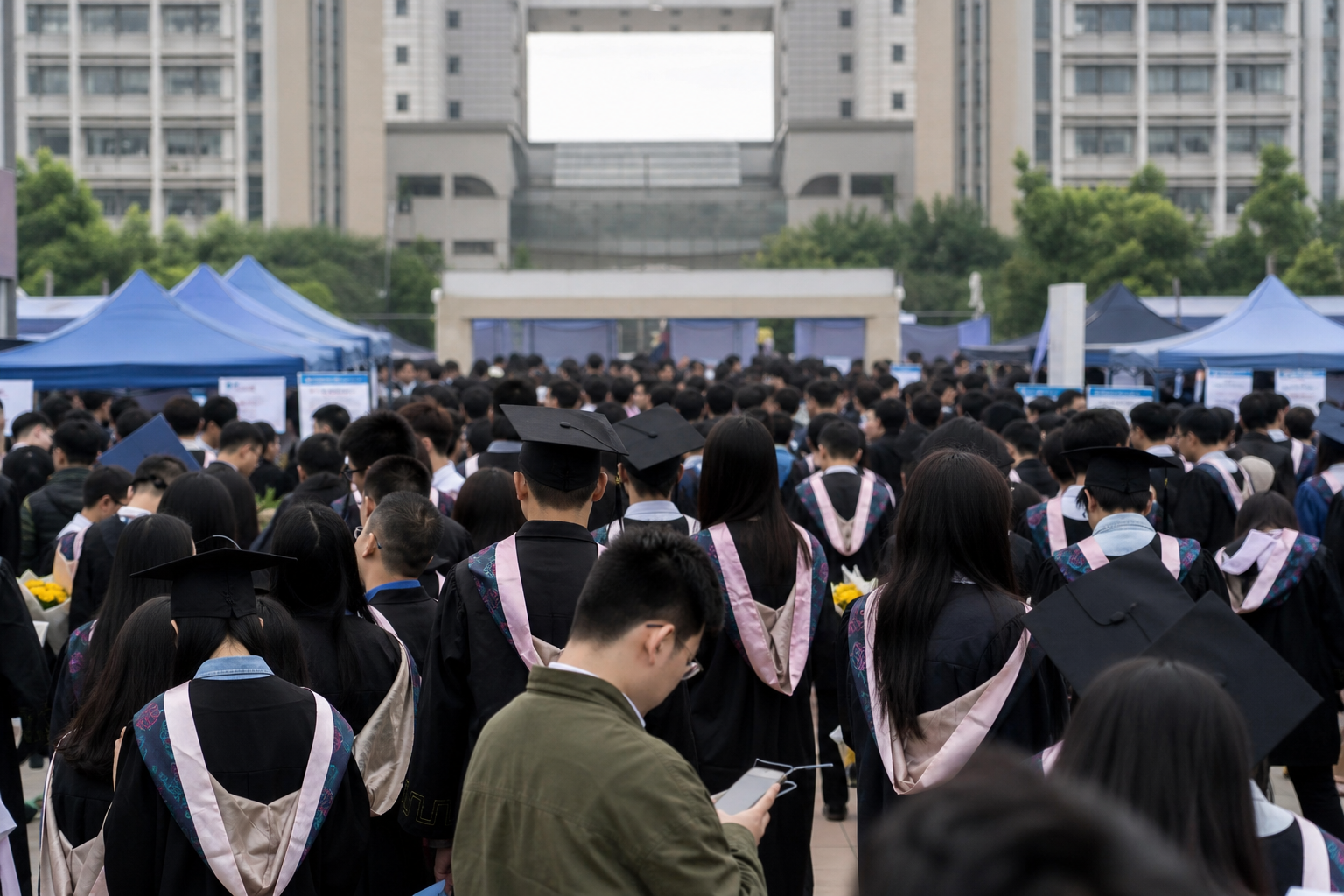
This summer, a record 12.7 million college graduates are expected to enter China’s labor market. For many of them, graduation is not bringing the sense of opportunity that earlier generations experienced. China still creates millions of jobs each year, but the competition for positions that young graduates want has become intense. The government itself has described employment pressure as high and has made graduate employment a major policy priority.
今夏、記録的な1,270万人の大学卒業生が中国の労働市場に参入すると見込まれています。その多くにとって、卒業は以前の世代が経験したような機会の感覚をもたらしていません。中国は今も毎年何百万人もの雇用を生み出していますが、若い卒業生が望む職をめぐる競争は激しくなっています。政府自身も雇用圧力が高いと述べ、卒業生の雇用を主要な政策課題としています。
At first, this may seem strange. China’s population has begun to shrink, so why are there more university graduates than ever? Part of the answer is a demographic lag. Today’s graduates were born about twenty years ago, before the recent fall in births had fully changed the number of young adults. The effects of today’s smaller child population will not reach universities for many years. In fact, the number of students taking China’s university entrance examination has already started to decline.
一見すると、これは奇妙に思えるかもしれません。中国の人口は縮小し始めているのに、なぜ大学卒業生はかつてないほど多いのでしょうか。答えの一部は人口動態の遅れです。今日の卒業生は約20年前に生まれており、最近の出生数の減少が若者の数を完全に変える前の世代です。今日の子どもの人口減少の影響が大学に届くまでには、まだ何年もかかります。実際、中国の大学入試を受ける学生の数はすでに減少し始めています。
There is another important reason: China has greatly expanded higher education. Going to university was once possible for a much smaller part of the population. By 2024, however, China’s gross higher-education enrollment rate had reached 60.8 percent. In other words, a much larger share of each generation now goes on to colleges and universities. This is an educational achievement, but it also means that the economy must create far more graduate-level jobs than it did in the past.
もう一つの重要な理由があります。中国は高等教育を大きく拡大したことです。大学に行くことは、かつては人口のはるかに小さな部分にしか可能ではありませんでした。しかし2024年までに、中国の高等教育の粗進学率は60.8パーセントに達しました。言い換えれば、各世代のはるかに大きな割合が今や大学・短大に進みます。これは教育上の成果ですが、経済が過去よりもはるかに多くの大卒向けの仕事を生み出さなければならないことも意味します。
The problem is not simply that China has “no jobs.” Different parts of the economy need different kinds of workers. Advanced manufacturing, electric vehicles, renewable energy and other industries continue to expand, while some traditional office and entry-level jobs have become harder to find. Many graduates hope for professional jobs in large cities, government organizations or well-known companies. Employers, meanwhile, may want technical skills or practical experience that graduates do not have. The result can be a mismatch between available workers and available jobs.
問題は、単に中国に「仕事がない」ということではありません。経済の異なる部分は、異なる種類の労働者を必要とします。先端製造、電気自動車、再生可能エネルギーなどの産業は拡大を続ける一方で、一部の伝統的なオフィス職やエントリーレベルの仕事は見つけにくくなっています。多くの卒業生は、大都市、政府機関、有名企業での専門職を望みます。一方で雇用主は、卒業生が持っていない技術スキルや実務経験を求めることがあります。その結果、利用可能な労働者と利用可能な仕事のあいだにミスマッチが生じえます。
This helps explain an apparent contradiction: a country can have unemployed graduates and still have employers that cannot find the workers they need. A university degree does not automatically match a particular occupation, location or salary. Some young people may have to accept work outside the field they studied, move to another region, or begin with a job they once considered below their expectations. The difficult question is whether this is a temporary adjustment or a deeper change in the value of a university degree.
これは一見した矛盾を説明する助けになります。国には失業中の卒業生がいる一方で、必要な労働者を見つけられない雇用主もいるということです。大学の学位は、自動的に特定の職業、場所、給与と一致するわけではありません。一部の若者は、学んだ分野以外の仕事を受け入れたり、別の地域に移ったり、かつて期待以下だと考えた仕事から始めたりしなければならないかもしれません。難しい問いは、これが一時的な調整なのか、大学の学位の価値におけるより深い変化なのかです。
The Chinese government is trying several approaches. It has encouraged private firms and state-owned enterprises to hire more graduates, expanded internships and training, and offered employers a subsidy for taking on young workers. A nationwide program running through the end of 2026 also provides job-search support, skills training and work-experience opportunities for graduates who have not yet found employment. Authorities are particularly promoting opportunities in advanced manufacturing, the digital economy and other growing industries.
中国政府はいくつかのアプローチを試みています。民間企業と国有企業により多くの卒業生を雇うよう促し、インターンシップと研修を拡大し、若い労働者を採用する雇用主に補助金を提供しています。2026年末まで続く全国的なプログラムも、まだ就職できていない卒業生に求職支援、技能訓練、実務経験の機会を提供しています。当局は特に、先端製造、デジタル経済、その他の成長産業での機会を推進しています。
For young people themselves, however, the problem is not only economic. Many grew up believing that studying hard, passing difficult examinations and earning a university degree would lead to a stable professional career. Their parents or older relatives may have entered the workforce when China was growing faster and there were fewer graduates competing for jobs. When that expected path no longer works, frustration can be understandable. Improving employability may help, but young people may also have to rethink what counts as a successful first job.
しかし若者自身にとって、問題は経済だけではありません。多くは、一生懸命勉強し、難しい試験に合格し、大学の学位を得れば、安定した専門職キャリアにつながると考えて育ちました。親や年上の親族は、中国がより速く成長し、仕事を争う卒業生が少なかった時代に労働市場に入ったかもしれません。その期待された道がもはや機能しないとき、不満は理解しうるものです。就職力の向上は助けになるかもしれませんが、若者はまた、成功した最初の仕事とは何かを考え直す必要もあるかもしれません。
And another change is arriving at the same time: artificial intelligence. Some of the tasks traditionally given to junior workers—basic research, writing reports, preparing simple content or handling routine office work—can increasingly be assisted or performed by AI. That does not mean that AI will simply eliminate graduate jobs, but it may change the first step of the career ladder. China’s graduate employment problem is therefore about more than finding 12.7 million jobs. It raises a larger question: How should young people begin their careers when education, the economy and technology are all changing at once?
そして同時に、もう一つの変化が到来しています。人工知能です。若手労働者に伝統的に与えられてきた仕事の一部—基礎調査、報告書の作成、簡単なコンテンツの準備、日常的な事務作業—は、ますますAIによって支援されたり実行されたりしえます。それはAIが単に大卒の仕事をなくすという意味ではありませんが、キャリアのはしごの最初の段を変えるかもしれません。したがって中国の卒業生雇用問題は、1,270万の仕事を見つけること以上のものです。それはより大きな問いを提起します。教育、経済、技術がすべて同時に変化しているとき、若者はキャリアをどう始めるべきなのか?